

A long time ago, I was a wallflower. I was quiet and kept to myself in a crowd. I’m still like that from time to time. When I’m in a gathering of people for the first time, I’ll keep to myself. But the more time I spend with a person or group of people, the more relaxed I become. In time, I’m yakking it up just like anyone else, until my social battery runs out. Then, I have to find my way home.
For those of you who have only known me for the past few years, I promise you that this is true. 😅 Up until I met and married Jamie, I was a loner for the most part. He encouraged me to open up, and now I wonder if he thinks I am too open. While he holds the title for extrovert between us, I can hold my own in a conversation with him. It’s hard to believe that once upon a time, I was a wallflower.
Hearing a lot and being unheard
Growing up in my generation meant hearing a lot about women being quiet and meek. I was under the impression that quietness and meekness meant being a wallflower. That I shouldn’t express myself or allow my opinions to be heard. This led me to store my feelings inside because quietness and meekness meant being unheard.
I wonder if I misunderstood those teachings.
Grinding my gears
I have spent time reading the account of Sarah and Abraham. Their story is interesting. I won’t be able to unpack everything about Sarah and Abraham today. There are more lessons in their story than there is time for me to share with you. But there is something new (to me) that I found interesting about Sarah.
God promised Abraham a son. According to the account, Abraham waited 25 years for Isaac to be born. He made a few missteps along the way. And I’m sure I would have done the same, probably worse. Even so, the way Abraham acted towards Sarah on a couple of occasions has always bothered me. It grinds my gears every time I read it. But this time, as I read about his actions, I understood something I hadn’t seen before.
*Abraham’s original name was Abram, and Sarah’s original name was Sarai. God changed their names later on. To make for easier storytelling, I will refer to them as Abraham and Sarah. This way, I do not have to explain it each time I mention them.*
He pawned her off
Early on in their story, when Abraham went to Egypt, he feared for his life. Thinking he would be killed because Sarah was beautiful, he decided to pawn her off as his sister. Yes, I know they were related, but the fact remains that Abraham deceptively told this half-truth. The beauty of Sarah drew Pharaoh (King of Egypt) as Abraham had predicted. He then took her to his house (Genesis 12:10-16).
I wonder how Sarah felt at that juncture. The Bible doesn’t say that she said anything. She was a wallflower. It seems that she just took the punches that life gave her.
In the following few verses, Pharaoh discovered that Sarah was Abraham’s wife and was angry with Abraham (Genesis 12:17-20). He was so upset about this that he returned Sarah to Abraham and ordered him to leave.
Still, Sarah didn’t say anything. She was a wallflower after all.
I wonder how she felt
Fast forward to Genesis 20. Some time had passed and God’s covenant with Abraham had been established. Abraham and his family spent time in an area called Gerar. Gerar was ruled by a king named Abimelech. What did Abraham do even after all he had experienced to that point? Out of fear for his life, he again claimed Sarah was his sister. Abimelech then took Sarah to his home.
Predictably, Abimelech found out that Sarah was Abraham’s wife; he was horrified (Genesis 20:1-18). He hurried to Abraham and returned Sarah to her husband. I wonder how she felt throughout this process. Did she think that no one cared about her life?
Again, Sarah said nothing. She was a wallflower.
She wasn’t perfect
I’m not saying Sarah was perfect. After all, she was the one who initiated Abraham taking Hagar to have a child for her (Genesis 16:1-15). Interestingly, Abraham didn’t oppose her plan. Oh, the tangled webs that we weave when we lack patience. God had already promised Abraham a large family. He said that his family would be as many as the stars of the sky (Genesis 15:1-6). But Sarah intervened when things looked impossible and sent Abraham to Hagar, who became pregnant and gave birth to Ishmael.
Genesis 15 is one of the few places in the Bible where Sarah is mentioned as speaking.
The Lord took note
In this story, timing is everything. God first promised Abraham a son in Genesis 15. It was after this first promise that Abraham fathered a son with Hagar. Then, in Genesis 17, God again promises Abraham a son and specifies that he would have a son with Sarah. About 25 years passed before the story reached the point where Sarah became pregnant with Isaac. This occurs in Genesis 21.
”Then the Lord took note of Sarah as He had said, and the Lord did for Sarah as He had promised.”
Genesis 21:1,2 NASB
I love reading that “the Lord took note of Sarah.” It gives me the impression that God turned His head and set His attention on her. She was a wallflower, but she was the one that God took note of.
And Sarah spoke
Then, as both of Abraham’s sons grew together, trouble arose. Sarah noticed Ishmael mocking Isaac. This bothered her. She told her husband to send him and his mother away (Genesis 21:9,10). I imagine that Sarah was the ultimate helicopter mom of her time. After waiting so long to have a child, she wanted to protect him. She didn’t want anything or anyone to pose a threat to him.
Torn, Abraham spoke with God. God promised to take care of Ishmael. He then instructed him to do “whatever Sarah tells you.”
On rereading this story through Sarah’s eyes, I gained a deeper understanding of one thing. While she was a wallflower to those around her, God took note of her. Her few words held weight and meaning. Abraham must have been startled that his wallflower wife spoke as sternly as she did to him. But God was using her to establish Abraham’s lineage.
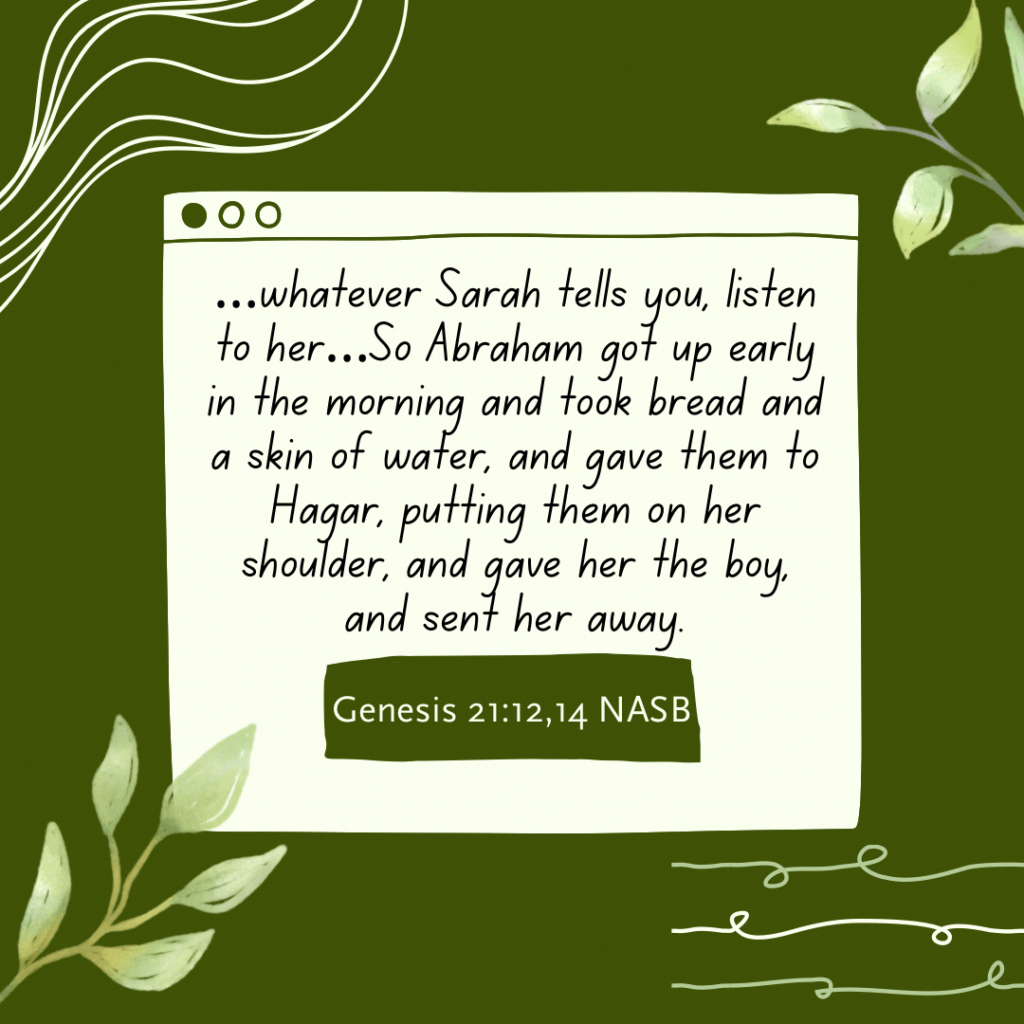
What is even more astounding is that this story took place in a society that was strictly patriarchal. In such a society, men’s words were law. But God told Abraham to do “whatever Sarah tells you, listen to her.” And he did. That must have made him the laughing stock of those around him. However, he cared more for God’s opinion than for those around him.
I admire Abraham in a new way today. He understood that God wouldn’t (and won’t) be told who to use. He listened to Sarah.
A reformed wallflower
As a reformed wallflower, I still try to keep my word count low. My prayer is for the words of my mouth to be few but weighty. I know He takes note.
You can receive new articles like this by joining the newsletter. I send occasional updates and new writing directly to subscribers.
If this post encouraged you, I invite you to partner with me on A Cultural Shift through Buy Me a Coffee. Your support helps keep A Cultural Shift’s outreach going. Thank you so much.
Related reading: If you like stories like Sarah’s the following may be encouraging to you as well:
The Strange Time of In Between


Pingback: I was in a spelling bee - A Cultural Shift